2026 Skills-First Hiring: Moving Beyond Degrees to Operational Impact
Stop hiring for provenance; start hiring for performance. Degrees are often just "operational drag" in an AI-driven environment. We show you how to audit your workflows, ignore the resume, and build a high-velocity team by focusing purely on immediate, friction-free operational impact.
HR PRACTICES
Truevine Connection
1/9/20262 min read
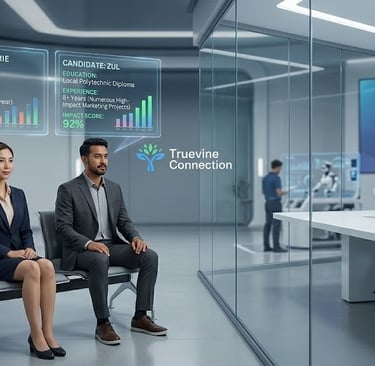
The Hidden Cost of the "Degree Trap"
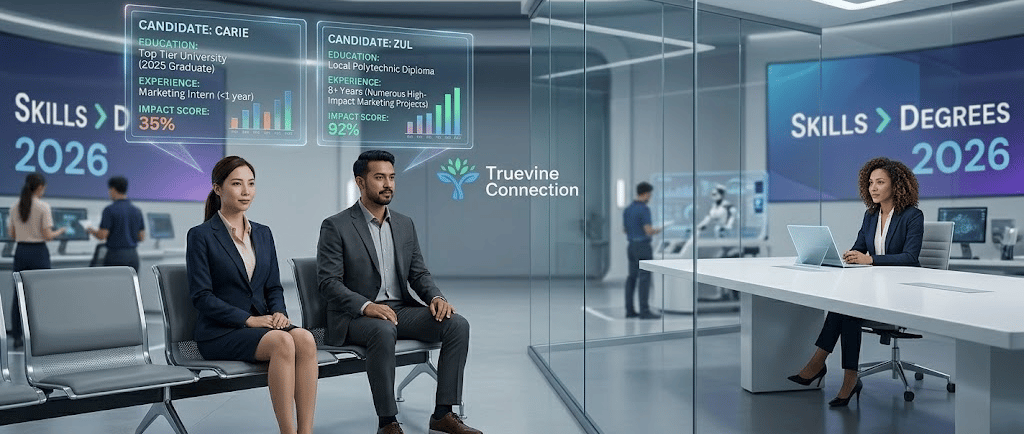
Singapore’s corporate landscape is currently grappling with a massive productivity paradox. While the latest industry reports from the Singapore Business Review and Aon highlight an aggressive push toward AI-augmented workflows, a significant number of firms are still tethered to a legacy recruitment metric: the university degree.
If your hiring strategy is still filtering candidates based primarily on institutional prestige rather than immediate operational velocity, you aren’t just behind the curve—you are intentionally creating operational drag. In 2026, talent is no longer about what you studied five years ago; it is about your capacity to integrate into an AI-driven system and produce results from Day 1.
Why "Skills-First" is an Operational, Not HR, Priority
Traditionally, "skills-based hiring" has been treated as a soft HR initiative—a way to promote diversity or broaden the candidate pool. But from an Organizational Development (OD) and Operations Management (OM) perspective, this is a fundamental error.
When you prioritize degrees, you are hiring for provenance, not performance. In a business environment where the half-life of a technical skill is shrinking, hiring for provenance results in a "retraining debt." You hire a candidate based on their past academic achievement, only to spend the next six months teaching them the actual operational skills required to function within your specific team architecture.
Truevine’s Perspective: Skills-first hiring is an operational risk-mitigation tool. It is about identifying the specific behavioral and technical competencies required to reduce friction in your current workflows.
Re-Engineering the Recruitment System
To move from degree-fixation to operational impact, leaders must stop asking, "Where did they study?" and start asking, "What is their operational integration time?"
Map the Workflow, Not the Role: Before drafting a job description, audit the workflow. Does this position require high-level analytical abstraction, or does it require rapid AI-tool execution? If the workflow demands execution, a degree is often a distractor.
Competency-in-Context Testing: Move away from theoretical interviews. Implement "day-in-the-life" simulations that test how a candidate manages a specific operational logjam using the tools your team currently deploys.
The Enneagram of Performance: Understand the personality structure of your high performers. If your team operates at high intensity, hiring a "high-achieving" degree holder who lacks the behavioral alignment to handle high-pressure feedback loops will create more internal friction than a skilled, self-taught practitioner.
High ROI Immediate Actions
For COOs and hiring managers who want to eliminate systemic drag, the transition to skills-first hiring starts with three specific moves:
Audit Your "Must-Haves": Go through your active job postings. If a degree is listed as a "must-have" for a role that primarily requires technical AI tool mastery, delete it.
Decouple Assessment from Resume: Use blind assessment platforms that score candidates on technical output before a human recruiter ever sees their education history.
Focus on 'Cognitive Elasticity': In an AI-driven environment, the most valuable skill is the ability to unlearn and relearn. During interviews, move from technical questions to "problem-solving process" questions—how do they troubleshoot when the AI output is wrong?
The Bottom Line
The "Skills-First" mandate isn't just about hiring fairness. It is about building an elastic, agile, and high-velocity organization that doesn't buckle under the pressure of rapid technological change. Degrees have their place, but they shouldn't be the gatekeeper for your company's operational survival.
Empowering organizations through comprehensive corporate wellness solutions and holistic employee well-being programs
© 2025. All rights reserved.