
Why Are We Buying Dual Monitors for Employees Who Can’t Even See Them?
If screen fatigue is quietly draining your team's energy, we can explore how simple, half-yearly visual checks on your office floor can help keep their focus comfortable and sharp.
EMPLOYEE WELLNESSHEALTH TIPS
Truevine Connection
6/26/20263 min read
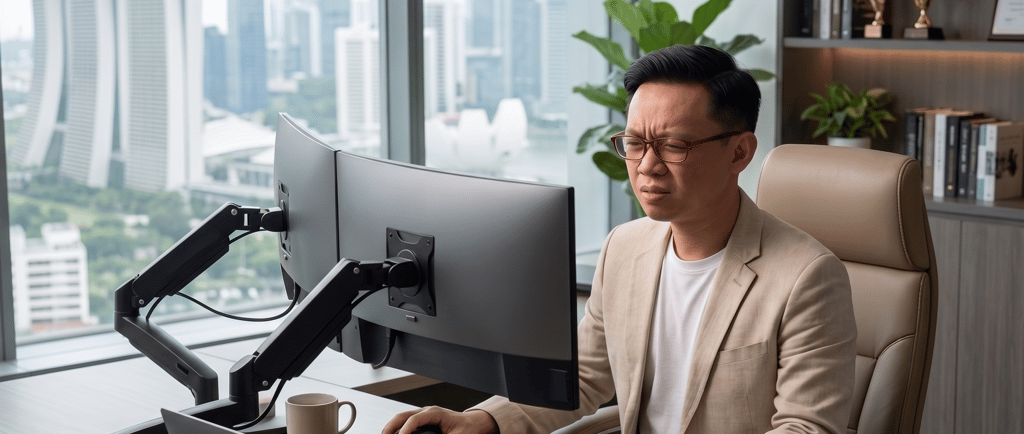
Let’s have an honest look at the state-of-the-art office setups we love to brag about on LinkedIn.
We boast about height-adjustable standing desks, ergonomic chairs, and high-end curved dual-monitor setups designed to help our teams "multitask at peak velocity."
But walk onto almost any office floor in Singapore at 4:00PM on a Thursday, and you’ll notice a bizarre, low-tech reality check:
Your most experienced, highly paid senior staff are sitting in those fancy chairs, leaning forward until their noses are practically touching the glass, squinting at microscopic spreadsheet cells with bloodshot eyes.
By late afternoon, the collective energy on the floor has hit a massive wall. People are rubbing their temples, blinking constantly, and staring blankly at their screens.
This isn't a lack of motivation. Their eyes literally feel like sandpaper.
Cutting Eyecare From Corporate Benefits is a Bad Idea
We are currently living through an unprecedented shift in Singapore’s workforce demographics. According to recent labor statistics, approximately 25% of our entire resident workforce is now aged 55 and older.
We tell the media how much we value their experience. Yet, because of outdated, reactive benefit structures, we expect these seasoned professionals to execute high-stakes decision-making with uncorrected, severely fatigued eyes.
Singapore is globally recognized as the "Myopia Capital of the World." But the strain goes far beyond simple short-sightedness:
Data from the National University Hospital (NUH) Department of Ophthalmology reveals that over 12.3% of Singaporeans suffer from clinical dry eye disease.
In a closed, air-conditioned office environment, dry eyes are accelerated by up to 300% because we blink up to 50% less frequently when staring at digital displays.
Despite this, standard corporate healthcare programs completely ignore active, preventive optical care.
Most legacy outpatient panels treat eye health as a purely "cosmetic" or "lifestyle" choice—as if needing glasses or dealing with dry, strained eyes is some optional aesthetic hobby. If an employee gets a sore throat, they get cashless panel coverage. If an employee's vision degrades to the point where screen fatigue is causing daily tension headaches and slowing their processing speed to a crawl, they are on their own.
If you wouldn’t run a precision automated factory line without maintaining its optical sensors, why are you letting your high-value human assets run your core operations with uncorrected, strained vision?
Blink More?
When management notices afternoon fatigue, the standard corporate response is incredibly passive. We stock the pantry with energy drinks, buy espresso machines, or send a monthly newsletter telling staff to "remember to blink" and "rest your eyes."
But let’s be operationally honest: passive advice does not work when your team is drowning in back-to-back deliverables. Telling an exhausted software developer or a busy accountant to "just take a break" while they are chasing a deadline is not a strategy; it’s a cop-out.
Nobody's heeding that blink more advice in the face of those datelines.
Optical Care In the Office
Protecting your team's eyesight doesn't require rewriting your entire corporate health insurance policy. It starts by transitioning from a passive, "sick-care only" mindset to active, visible care on the floor.
Instead of letting optical strain run your afternoon productivity into the ground, progressive companies are introducing half-yearly physical and visual health checks. By bringing a curated panel of allied health practitioners—including mobile optical specialists and eye-ergonomics experts—directly onto the office floor twice a year, you bypass the friction entirely:
On-Site Screen-Fatigue & Visual Diagnostics: Bring authorized, non-invasive digital screeners directly to the desk. Run rapid, 10-minute diagnostic checks to catch early signs of glaucoma, severe dry-eye inflammation, and progressive visual strain before they trigger chronic headaches.
Workstation Glare & Light Audits: Address the physical environment. Run rapid light audits on the office floor to eliminate the harsh overhead fluorescent glare that forces employees to hunch forward and squint.
Active Visual Restores: Educate teams on practical, hands-on micro-habits—like the 20-20-20 rule (looking 20 feet away for 20 seconds every 20 minutes)—to physically break the ocular spasm during intense project sprints.
Your employees should be able to do more than just squint at their screens. Let's make their visual health an active priority, right on the office floor.
Empowering organizations through comprehensive corporate wellness solutions and holistic employee well-being programs
© 2025. All rights reserved.